This article also appeared in Science In My Fiction
A common characteristic of “advanced races” in science-fiction is the ability to communicate without using speech, gestures, or writing, but with their brains. Telepathy can be an inherent ability powered by “magic”, or it can be granted by implanted radios. Though one has to wonder what kind of effect this has on their society, specifically relating to their ability to keep secrets or to deceive one another.
Some say that relationships, and by extension civilizations, are founded on lies and held together by secrets. I expect that would be very hard if everyone could read everyone else’s minds. If such a society existed they would either have to be completely honest and keep no secrets from one another; or they’d make scanning another’s thoughts without permission a serious taboo or crime. In fact, one might expect a naturally telepathic species to be colonial organisms.
And as for collective consciousnesses, most portrayals involve each member broadcasting their every thought to everyone else in the collective, unless they’re all remotes controlled by the queen of course. This shouldn’t be a problem if they are all born into the hive like ants are, but if they were individually sapient beings (such as humans) who joined together as adults their individual pasts might come into conflict. If, for example, a married couple were to join such a group mind would it bring them closer, or tear them apart?
Some possibilities for writing:
• Humanity encounters a telepathic alien race that can only read each other’s minds, human brains are closed to them except through conventional communication. They have no concept of deception and cannot tell when humans are lying to them.
• In the near future brain-computer interfaces are ubiquitous and allow full thought-to-thought communication between two or more people. Someone develops a program similar to Twitter except that it posts thoughts instead of short texts.
• Software that allows constant mental communication between multiple people is developed and becomes the next big thing, followed by a surge of divorces and violent crime.
Thursday, December 23, 2010

Wednesday, August 11, 2010
Don't blame the scientists
We are the wizards, the sages, the alchemists, the physicians, the medicine men,
All are free to see what we have seen, but so few want to. They refuse to understand, simply believing the lies told to them by their priests hiding behind their guise of the will of the people.
We tell them of great wonders waiting for them if they only go to look, but they hide in ignorance.
We travel to the depths of the atom and the very heights of the heavens. And they refuse to follow.
We know why plants grow, why water flows downhill, why someone dies when their heart is ripped out of his chest.
We tell others, but they do not listen.
Some have compared scientists to religious priests, that we claim to know things that the public doesn't. But there is a key difference, priests pretend to have knowledge the public doesn't know, scientists don't, we really do know things that most of humanity doesn't know. One can easily obtain knowledge of science, all you need is the will to learn it. The problem is that most people only want to learn the interesting bits, the results, and those just can't be taken out of context. Most scientists just can't explain to the average high school graduate who failed chemistry how a nuclear fusion reactor works (and why it won't blow up the city) without giving a detailed explanation of nuclear physics that takes most people years to finish. And what's worse, journalists and politicians keep reducing scientist's great works to ten-minute blurbs laced with their own agendas.
All are free to see what we have seen, but so few want to. They refuse to understand, simply believing the lies told to them by their priests hiding behind their guise of the will of the people.
We tell them of great wonders waiting for them if they only go to look, but they hide in ignorance.
We travel to the depths of the atom and the very heights of the heavens. And they refuse to follow.
We know why plants grow, why water flows downhill, why someone dies when their heart is ripped out of his chest.
We tell others, but they do not listen.
Some have compared scientists to religious priests, that we claim to know things that the public doesn't. But there is a key difference, priests pretend to have knowledge the public doesn't know, scientists don't, we really do know things that most of humanity doesn't know. One can easily obtain knowledge of science, all you need is the will to learn it. The problem is that most people only want to learn the interesting bits, the results, and those just can't be taken out of context. Most scientists just can't explain to the average high school graduate who failed chemistry how a nuclear fusion reactor works (and why it won't blow up the city) without giving a detailed explanation of nuclear physics that takes most people years to finish. And what's worse, journalists and politicians keep reducing scientist's great works to ten-minute blurbs laced with their own agendas.
Monday, August 9, 2010
Astral Cyberspace
I've thought about it, and the only way that a spiritual world could possibly exist is if it was some kind of "telepathic internet". The afterlife would be a virtual world inhabited by simulations of dead people, possibly with some of their uploaded memories. Gods would be artificial intelligences running in the subconsciousnesses of their worshipers, containing the combined Ids of a ton of people might explain why gods tend to be so emotional. It would also lend some credence to the Church of Satan's view on gods.
Open Source Artificial Intelligence
One of my greatest fears for the future is Artificial Intelligence that has no empathy for humanity, so I think it would be much safer to upload human brains than to build an AI from scratch. However there is a slight possibility that emotionless AI will be much cheaper than making a working copy of a human brain. So here's a thought, why not make Brain Emulations (and possibly AI that have proven their sapience and ethics) Open Source. That way AIs that are less likely to wipe out the human race because it gets in the way could become more common than AIs that would with comparable processing power. Granted, unreasonably paranoid government officials are likely to make doing this illegal, but that will only make it more enticing for some hackers. And there is the possibility that someone will obtain a uploaded persona and try to alter it since it's open source, however I doubt that the program would like that, and if I were you I wouldn't try to piss off my computer if it were sentient, especially if there's a chance you could remove it's morality centers by mistake.
Friday, July 23, 2010
Why you can't backup people

In the latest episode of Futurama Bender discovers that he has a serious design flaw, he was built without a backup device, making him mortal like a "meatbag" instead of immortal like most robots. He naturally does not take the news well, what he doesn't realize is that even if he did have a backup device he would still be able to "die" because all the backup would be is a copy, it wouldn't be him any more than those robot duplicates of Fry and Leela from the first episode of the season. Of course, no one would be able to tell the copy from the original, he would have the same kleptomania as the old Bender, but there would be no continuity between the original and the copy, that is what's important.
These robots have the right idea:
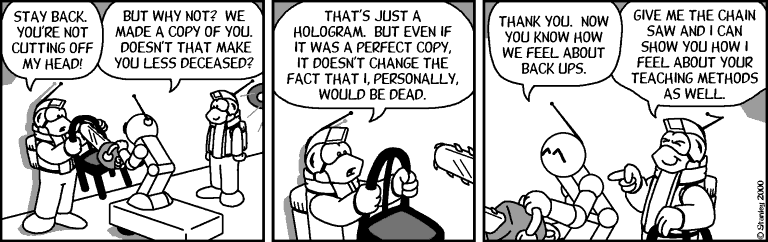
From Freefall by Mark Stanley
Monday, June 14, 2010
Why don't we have augmented reality?
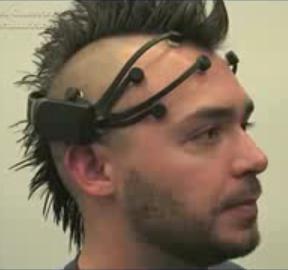
I keep seeing brainwave reading headsets being used in toys and computer games, I also recall seeing VR "sunglasses" for watching iPod movies in those "SkyMall" catalogues on airplanes. So I ask, why has no one combined the two yet? The EEG would allow someone to work a attached smartphone without touching it and the glasses would make bending over to look at it unnecessary, though the level of concentration required would probably make texting while driving ill-advised. Also it would allow Virtual reality without those bulky gloves. Granted it would be expensive, VR glasses often cost $200-$500 and the cheapest EEG headset I saw was $99, but the cool factor alone should make it profitable (you reading this, Bill Gates?)
Thursday, June 10, 2010
To all AI designers out there, program for compassion not empathy

Do you know, the difference between an Aspergarian and a psychopath? The answer is probably found in how they would respond to a Vioght-Kampf test from Blade Runner. "You are walking through the desert, you see a tortoise, you flip it over onto it's back..." An Aspie might state that they would flip the tortoise back over once it was obvious it couldn't do that itself; a psychopath would say the same, if they had figured it out, in reality they would most likely watch it bake in the sun. The difference is compassion, not empathy, the ability to gauge another's emotional responses is secondary to being able to "feel" for another.
I am stating this because some involved in the field of AI research have warned to beware of creating a superintelligence with "hyper-Asperger's". And I am worried that this may result in programmers designing an AI with a database of emotional responses and what usually triggers them, but forgetting to program actual compassion. So, at the very least we should prevent AIs from seeing Blade Runner and do a compassion test as well as the Turing test.
Subscribe to:
Posts (Atom)