We are still a very long ways from making a computer that can pass for human, but recently two developments put us a bit closer to that goal...
...unfortunately.
For one thing, psychiatrist Ralph Hoffman of Yale and computer scientist Risto Miikkulainen of the University of Texas, Austin have made a schizophrenic computer. In an attempt to uncover the roots of the disorder in humans they took an artificial neural network known as DISCERN and began feeding it "stories" while inflicting different forms of damage to its modules. ANNs are programs designed to mimic the processes of a biological brain by isolating small sections of code called "modules" and forming a network between them, rather than being explicitly told what to do like a conventional program DISCERN has to learn the proper response to a given input. To test DISCERN they fed it short stories told in either first or third person and had it repeat the tales back to them. Once the machine had learned how to understand and repeat a story like a normal human adult the researchers began to modify the modules in different ways to mimic various forms of brain damage. In one instance they reprogrammed the memory encoder to learn at an accelerated rate so that it would remember story details normally dismissed as irrelevant.
However, instead of learning faster it got confused, mixing up stories with different plot lines and inserting itself into third-person stories, at one point claiming it had planted a bomb (a detail in a story about a terrorist attack). This resembled the symptoms of schizophrenia known as derailment and delusion, leading the researchers to conclude that accelerated learning might be a cause of schizophrenia.
While this was intentional, it seems to me that an AI could be programmed with a dangerously fast learning rate and go insane by accident.
Now, in slightly less risky to the continued existence of the species news Google is funding a project to teach computers regret. The project most likely will not actually give machines the ability to feel emotion but it should allow them to measure the distance between the desired result and actual results. Hopefully convincing them to try better next time, and with any luck "don't kill humans" will always be in the objective list.
mIGHt wE stILL hAve hopE?
Showing posts with label Computers. Show all posts
Showing posts with label Computers. Show all posts
Thursday, May 19, 2011

Monday, August 9, 2010
Open Source Artificial Intelligence
One of my greatest fears for the future is Artificial Intelligence that has no empathy for humanity, so I think it would be much safer to upload human brains than to build an AI from scratch. However there is a slight possibility that emotionless AI will be much cheaper than making a working copy of a human brain. So here's a thought, why not make Brain Emulations (and possibly AI that have proven their sapience and ethics) Open Source. That way AIs that are less likely to wipe out the human race because it gets in the way could become more common than AIs that would with comparable processing power. Granted, unreasonably paranoid government officials are likely to make doing this illegal, but that will only make it more enticing for some hackers. And there is the possibility that someone will obtain a uploaded persona and try to alter it since it's open source, however I doubt that the program would like that, and if I were you I wouldn't try to piss off my computer if it were sentient, especially if there's a chance you could remove it's morality centers by mistake.
Monday, June 14, 2010
Why don't we have augmented reality?
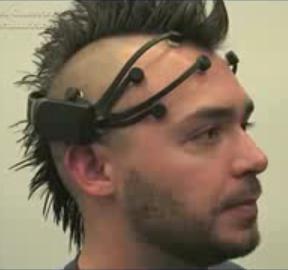
I keep seeing brainwave reading headsets being used in toys and computer games, I also recall seeing VR "sunglasses" for watching iPod movies in those "SkyMall" catalogues on airplanes. So I ask, why has no one combined the two yet? The EEG would allow someone to work a attached smartphone without touching it and the glasses would make bending over to look at it unnecessary, though the level of concentration required would probably make texting while driving ill-advised. Also it would allow Virtual reality without those bulky gloves. Granted it would be expensive, VR glasses often cost $200-$500 and the cheapest EEG headset I saw was $99, but the cool factor alone should make it profitable (you reading this, Bill Gates?)
Thursday, June 10, 2010
To all AI designers out there, program for compassion not empathy

Do you know, the difference between an Aspergarian and a psychopath? The answer is probably found in how they would respond to a Vioght-Kampf test from Blade Runner. "You are walking through the desert, you see a tortoise, you flip it over onto it's back..." An Aspie might state that they would flip the tortoise back over once it was obvious it couldn't do that itself; a psychopath would say the same, if they had figured it out, in reality they would most likely watch it bake in the sun. The difference is compassion, not empathy, the ability to gauge another's emotional responses is secondary to being able to "feel" for another.
I am stating this because some involved in the field of AI research have warned to beware of creating a superintelligence with "hyper-Asperger's". And I am worried that this may result in programmers designing an AI with a database of emotional responses and what usually triggers them, but forgetting to program actual compassion. So, at the very least we should prevent AIs from seeing Blade Runner and do a compassion test as well as the Turing test.
Thursday, January 7, 2010
A possibility on the future
Imagine, that technology has advanced to the point where a complete copy of your personality and memories can be made through a process as simple as an MRI is today. And that two or more people with the appropriate implants can perceive through each other's senses and "hear" each other's thoughts, to the point where it can be difficult to distinguish whose thoughts and experiences are whose. Now imagine that you have those implants and that you have an AI copy of yourself made. Once your copy is activated your implants are linked to it, the copy doesn't have a chance to form an independent thought and essentially becomes an extension of your own mind. You become much better at multi-tasking as now you essentially have two brains, you can battle orcs while you're in a meeting with your boss. You can use one brain to work while your other is on vacation. Maybe you have an android that your AI self can teleoperate if you ever need to be in two places at once. But then one day you feel a sudden flash of pain and all sensory input from your biological body cuts out, frantically you check all your life signs. Pulse: zero; brain activity: flat-lined; you come to one conclusion, you are dead.
Sunday, September 6, 2009
Why a single system cannot work (aka, why the Democrats would have to be idiots if the conservatives were telling the truth about them)
One of the things that the Right in this country is saying about Health Care reform is that it will abolish private health insurance and require everyone to be on the government's one system. Aside from the fact that the actual bill says that they are only providing an option it would be moronic to force everyone to use the same system (a quick search on wikipedia shows that England and Canada still have private insurance despite most using the public option). People are different, what works for one person won't necessarily work for another.
I have realized this not because of my experience with health insurance (though my family has experienced difficulty getting approved because of my autism, my mother's pituitary, and my brother's wrists), but because of my University's policies on antivirus software. The school provides a variation of Symantec corporate edition free of charge and it seems to work for most people but for some reason it doesn't on my computer (I had it my first semester and I needed to get my computer wiped twice because of the connectivity and start-up problems it caused). But the real problem is that a program called Cisco Clean Access Agent is also required, if your antivirus software is not approved it doesn't let you access the internet, however it ceases to recognize a program that isn't the school provided one after a major update (for example, Norton Internet security going from v.16.5 to v.16.7 over the summer). So I'm going to sign out and watch Babylon 5 before my guest access ends now.
I have realized this not because of my experience with health insurance (though my family has experienced difficulty getting approved because of my autism, my mother's pituitary, and my brother's wrists), but because of my University's policies on antivirus software. The school provides a variation of Symantec corporate edition free of charge and it seems to work for most people but for some reason it doesn't on my computer (I had it my first semester and I needed to get my computer wiped twice because of the connectivity and start-up problems it caused). But the real problem is that a program called Cisco Clean Access Agent is also required, if your antivirus software is not approved it doesn't let you access the internet, however it ceases to recognize a program that isn't the school provided one after a major update (for example, Norton Internet security going from v.16.5 to v.16.7 over the summer). So I'm going to sign out and watch Babylon 5 before my guest access ends now.
Subscribe to:
Posts (Atom)