Friday, July 23, 2010

Why you can't backup people


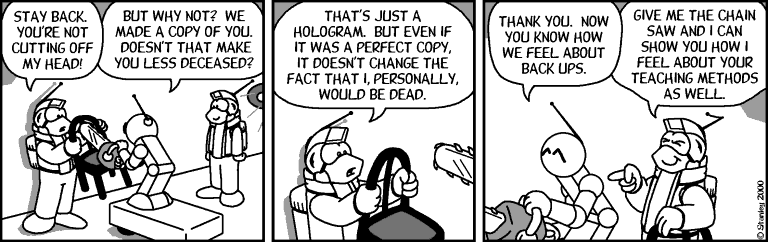
In the latest episode of Futurama Bender discovers that he has a serious design flaw, he was built without a backup device, making him mortal like a "meatbag" instead of immortal like most robots. He naturally does not take the news well, what he doesn't realize is that even if he did have a backup device he would still be able to "die" because all the backup would be is a copy, it wouldn't be him any more than those robot duplicates of Fry and Leela from the first episode of the season. Of course, no one would be able to tell the copy from the original, he would have the same kleptomania as the old Bender, but there would be no continuity between the original and the copy, that is what's important.

These robots have the right idea:

From Freefall by Mark Stanley

Monday, June 14, 2010

Why don't we have augmented reality?


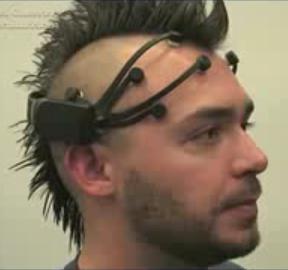
I keep seeing brainwave reading headsets being used in toys and computer games, I also recall seeing VR "sunglasses" for watching iPod movies in those "SkyMall" catalogues on airplanes. So I ask, why has no one combined the two yet? The EEG would allow someone to work a attached smartphone without touching it and the glasses would make bending over to look at it unnecessary, though the level of concentration required would probably make texting while driving ill-advised. Also it would allow Virtual reality without those bulky gloves. Granted it would be expensive, VR glasses often cost $200-$500 and the cheapest EEG headset I saw was $99, but the cool factor alone should make it profitable (you reading this, Bill Gates?)

Thursday, June 10, 2010

To all AI designers out there, program for compassion not empathy


Do you know, the difference between an Aspergarian and a psychopath? The answer is probably found in how they would respond to a Vioght-Kampf test from Blade Runner. "You are walking through the desert, you see a tortoise, you flip it over onto it's back..." An Aspie might state that they would flip the tortoise back over once it was obvious it couldn't do that itself; a psychopath would say the same, if they had figured it out, in reality they would most likely watch it bake in the sun. The difference is compassion, not empathy, the ability to gauge another's emotional responses is secondary to being able to "feel" for another.

I am stating this because some involved in the field of AI research have warned to beware of creating a superintelligence with "hyper-Asperger's". And I am worried that this may result in programmers designing an AI with a database of emotional responses and what usually triggers them, but forgetting to program actual compassion. So, at the very least we should prevent AIs from seeing Blade Runner and do a compassion test as well as the Turing test.

Sunday, May 9, 2010

Why People, Or Superintelligences, Need Others

I just finished writing my final essay for my philosophy class this semester, and realized how some of the points I brought up might be used as reasons for a Superintelligence capable of wiping out humanity and existing by itself might keep us around.

Here's the essay in full, what do you think?:

Aside from the practical reasons, mutual protection, cooperation in gathering food, reproduction, one sometimes wonders why we need other people in our lives. In Being and Nothingness Jean-Paul Sartre states that feelings such as shame, pride, etc, are due to being looked at and objectified by another. He also states that this objectification gives one density of presence. Essentially, one needs attention from someone else. But they also want control, power, when you look at me I become an object; but when I look at you, you become an object. You can take my possibilities from me, and I can do the same, you are the Other and I can subvert you. Of course, we may be entangled with others so much that other people form a large part of our identities. Even Nietzsche hinted at knowing this in his essay on the signs of high and low culture, though he had a slightly different reason for why we would need other people.
Sartre puts a lot of emphasis on “the Look” that another person gives to you. He even refers to the Look as a ‘fall’ in the pseudo-religious sense, as in a loss of innocence. The world seems to drain into the other and reduces oneself to just another object like everything else in the world to that other person. This takes away most of the possibilities available to the person being looked at, it is a loss of control. Once he arrives your possibilities are threatened by his possibilities. However the Look also gives the looked at density of presence, he feels validated. “The Other’s look confers spatiality upon me. To apprehend oneself as looked-at is to apprehend oneself as a spatializing-spatialized.”(1). And of course, you can take away the other’s possibilities just as easily as he can take away yours, which might give you a sense of control over the situation and the other, which Sartre believes is what the lover seeks. The lover wants control over how the beloved looks at him, using his own object-state to manipulate how she sees him. However, the lover also doesn’t want to “compromise the freedom of the other” as it wouldn’t be as satisfying. But most of the time a person is trying to control another, even the masochist who desires to be treated as an object is just using the dominatrix who he wants to be used by.
There is another possibility for why we need to have others in our lives, the concept of Martin Heidegger’s that we are all entangled with “the They”. You see, in everyday being with others “Da-sein stands in subservience to the others.”(2) Da-sein, loosely translated, means being-there or there-being, Heidegger used it to mean one’s personal presence, their being in the world. Being in the world we have associational relationships with various objects that exist in the world, including other people. But other people have different perspectives than one person does and your Da-sein can be easily lost in the inauthentic Da-sein of the they. The public world surrounding oneself dissolves one’s Da-sein into that of the others, disburdening individual Da-sein in its everydayness. One becomes entangled in the they and in fact falls towards the they, fleeing from self-awareness and all that painful inner worldly thinking. Actually that last sentence, and how it is stated in the book, might actually be in the wrong tense, it seems to suggest that the fall into the they hasn’t happened yet. Also the terminology suggests that “falling prey” is a bad thing when Heidegger specifically states not to place value judgments on entanglement of Da-sein. While we can’t say whether or not being entangled in the collective Da-seins of the world is a good thing it does help people get along with their day to day lives.
Friedrich Nietzsche actually had a good reason for someone to break away from the others, though he didn’t use the same terminology. He viewed tight societies as super-organisms of a sort, and he noticed that many individuals who were weakened in one organ compensated by making other organs stronger, for example a blind man had better hearing and could see deeper inwardly. To him those individuals who were less bound represented a “wound” in society that helped it to advance. In terms of functionality in society “the stronger natures retain the type, but the weaker ones help to advance it.”(3) He then goes on to divide people into “bound spirits” and “free spirits”; free spirits are strong, but also weak, especially in their actions as they have too many motives and are therefore uncertain and awkward. The bound spirit on the other hand has tradition on his side and does not need to explain his actions, allowing him to be very strong and assertive in action. A genius, a true genius not the generic IQ>150 kind of genius, would be a free spirit who can also assert himself as effectively as a bound spirit, without needing to appeal to the bound spirits. But to unlock the true potential of a genius might require one to break free from the bindings of society, in the same way that a prisoner might be inspired to develop skills related to escaping. So we need other people and specifically the tightly bound societies they form in order to create true Free Spirits, who are necessary to prevent humanity from stagnating. In addition those Free Spirits might lead to something that transcends humanity, the Ubermensch, of course that might not be a good thing, but they’ll still need normal Mensch for the same reason as the genius.
So, in effect we have two reasons why people need other people, Sartre’s “look” and both Heidegger and Nietzsche’s concepts of multiple people interacting as one person and distinction of those who break away. Although the feeling of validation given by the look and the everyday convenience of the they probably matter more to the average person than the motivating pressure of society to produce genius. But everyone wants control, control provides security, it provides stability and prevents any unexpected complications in your life and/or plans. There is no denying that other people can be a hindrance, but they can also be advantageous, if you can manipulate them properly. Plus there is the sense of satisfaction you get when you’ve made the other into just another object in the world. So the main reason why we need others is still because we want to use them. But really you can’t accept just one of those explanations on its own, they’re all entangled with one another, just like we are as individuals within the they.

References:
1. Sartre, Jean-Paul. (1956). Being and Nothingness. Philosophical Library, Inc. Page 266.
2. Heidegger, Martin. (1953) Being and Time. State University of New York (1996 reprinting). Page 118 and 199.
3. Nietzsche, Friedrich. (1878). Translated by Marion Faber (1984). University of Nebraska Press. Page 138

Thursday, April 29, 2010

Aliens, psychology by diet

When we expand into outer space, we may contact other sapient species, and it can be guaranteed that they will think differently than us. But we may be able to predict their behavior by their diet. Something that Larry Niven touched on with the carnivorous Kzinti and the herbivorous Puppeteers.

Carnivores: The first thing you should remember is that predators are opportunists, they always take the route that is least expensive. If they get to colonizing other planets I would expect them to have the capability to adapt considering their need for complex ecosystems that would be a hassle to terraform from scratch. Due to their opportunistic natures I doubt that they might go to the trouble of eating other sapient species like us humans, though if there is a massive technological difference they might enslave or domesticate the less advanced species. Relations with humanity would probably be neutral or even allies, we might colonize and terraform dead worlds while they adapt to living ones.

Herbivores: To an herbivore, any other animal is a potential enemy, a predator or a competitor. I expect that their planets would be ecological disasters devoid of any other animal species except in the most extreme regions they never got around to colonizing. Since their supporting ecosystems would be comparatively simple they would probably terraform their colonies, because of that I expect that they would use a lot of weapons of mass destruction in inter-species wars. In addition the fact that extreme paranoia would have been a survival trait in their early history (more than humans anyway) would make diplomacy with them very difficult.

Omnivores: Would probably be closest to humans psychologically, as we are omnivores ourselves. Kind of a wild card, they might terraform, they might adapt, they might exterminate, they might enslave. They might even join forces with us and form the galactic federation. Fortunately trends on earth make it seem like most sapient species will be omnivorous.

Plants: I don't see any reason for plants to become sapient, but maybe a machine civilization would be similar. In short, they wouldn't care about consumers unless we got in their way.

Wednesday, April 28, 2010

One of my Philosophy Papers

I don't really have much else to write about, so I'm posting a few of the papers I've written for my Philosophy classes.

Second Reaction Paper: The They

Paul Schroeer-Hannemann

Martin Heidegger’s idea of Da-sein and the “They” is quite intriguing, I see resemblances between his ideas and Nietzsche, as well as some similarities to concepts I’ve read about in science-fiction, and things I’ve seen in the real world. The concept that inauthentic Da-sein is entangled in the They and that only those who break away can achieve true Da-sein seems similar to one of the aspects of Nietzsche’s Übermensch, specifically rising above the herd. It seems like my favorite philosopher of the 19th century had a bigger influence than I realized. The They also reminds me of the idea of the Group Consciousness, which has often been extended into a “Hive Mind” in science-fiction.

It might seem ridiculous to imagine a large group sharing one consciousness, but it can be rather easy to change your mind on that when you witness fads and trends sweeping through the population. It’s like there’s some group mind, but not everyone is connected to it to the same extent, or that there are several collectives and each person is part of several.

It seems contradictory how Heidegger calls entanglement in the They “falling prey” and states that it is not a “fall”. Of course, he meant a “fall” in the religious manner and he originally wrote that in Deutsch. But it still seems like he’s suggesting that entanglement is a bad thing, even calling one who is entangled “inauthentic Da-sein”. Why tell people not to project value judgments while using terminology that encourages them to? It’s like he’s intentionally confusing us, or do all philosophers do that?

What does make sense is flight towards the They and away from self-awareness. People tend to feel more secure in groups and insecure when they don’t know what to do. Being part of the group distracts people from self-contemplation and the potential revelations that might bring, shattering their comfortable worldview. It’s much easier to just have someone tell you what to think, especially if it’s simple enough for a child to understand (this applies to both philosophy and science). The Emo “subculture” seems like a perfect example, teens become angsty about their worldviews being slightly shaken by puberty and what they’re taught in high school and flee from self-awareness by subsuming themselves within the They, all while under the delusion that they are expressing their individuality. Even when they try to make themselves unique they are just following the will of the They to express ones “uniqueness”. In fact it appears that the smaller the group, the more entangled its members are; or perhaps it is just easier for some members of the group to influence the others, actually that is entanglement isn’t it. It doesn’t seem like there is any way to avoid entanglement in at least one They, so I guess it’s a good thing that Heidegger said not to project value judgments on Falling Prey.


Tuesday, February 9, 2010

Armor and Authoritarianism, a possible connection?

As well everyone knows, the shiny knights of the Middle Ages were made obsolete by the invention of guns. Many also realize that with the invention of a very deadly, easy to use weapon it became much more difficult for rulers to maintain control of their subjects. It is no coincidence that governments, in particular authoritarian ones, don't last as long as they used to.

With those in mind I looked at the Wikipedia page on Roman military equipment and my suspicions were confirmed, Roman soldiers wore considerably heavier armor after Caesar took power than when Rome was a republic. Able to survive attacks that would kill someone less well protected, courtesy of their emperor, the Roman legions were able to put down peasant rebellions easily. Their successors after the empire's fall were even better suited to enforcing the will of their feudal lords. That all disappeared when the peasants became able to kill a knight at 100 paces; within a few centuries the only monarchs who hadn't been deposed were those who turned over most of their power to democratic institutions such as Britain's.

In short, when personal armor technology can effectively protect against the most commonly used weapons technology, authoritarianism thrives because armor is too expensive for the average peasant to acquire. These days most authoritarian regimes die with their first ruler. However, while the bulletproof vests given to most soldiers can be easily penetrated by a civilian hunting rifle, there have been considerable advances in personal armor tech within the last 50 years. It is possible that within a century soldiers will be nigh-invulnerable against anything short of heavy explosives.

Personally I welcome the Terran Federation and the Mobile Infantry, will be better than this democratic chaos.