Thursday, November 18, 2021
The Superhero Genre and Transhumanism
I've decided to revive this blog after a long absence, I've been putting most of my effort into my worldbuilding project at the Para-Imperium.
For starters I thought I'd repost my essays on the contrast between transhumanism and the superhero genre, originally posted here and here.
Superheroes: Individuals with special skills, equipment, and in particular, powers that they use to fight criminals both “mundane” and superpowered like themselves. They might have mutations from laboratory accidents or accident of birth, they might have been augmented with cybernetics after sustaining horrific injuries, they could have escaped from a secret super soldier project, or maybe they weren’t human in the first place.
Transhumanism: The philosophy that the limitations of the human body should be “transcended” through the use of technology. Specifically, technology internal to the body such as cybernetic implants or genetic modification. The hope is that such tech will make people hardier, smarter, longer-lived, potentially even immortal.
Now, one might be forgiven for thinking that superheroes were prime examples of transhumans, but in truth the majority couldn’t be farther from them. You see, most transhumanists see the ability to choose to enhance oneself a right that should be available, though they might disagree on how one gains access to enhancement. While very few superheroes willingly obtain their powers, and if they do they either refuse to share the source of their powers or plot happens to prevent others from following in their footsteps. Captain America’s probably the closest to the transhumanist ideal as he volunteered for the super soldier project, but the serum was destroyed after his enhancement. Iron Man and Black Panther on the other hand, could make the sources of their powers available to the world, but choose not to for fear that “the wrong people” could misuse them.
Of course, the main reason why superheroes can’t share their superpower sources with the world is sales. The big two comic book publishers in particular have been running their big titles for the better part of a century and they can’t risk making too many big changes to the status quo in the story, hence any world-shattering events like mass produced superpowers can’t stick. That’s also why superheroes and villains rarely stay dead.
The secondary reason why superhero stories are anti-transhuman is that supers are by necessity exceptional people who accept or reject “the burden of protecting the mundanes.” Writers need a reason why these particular people are fighting crime or attempting to conquer the world, and it would be much more difficult to justify their actions if everybody had superpowers. Though frankly, I think Syndrome from “The Incredibles” said it best: “...when everybody’s special, nobody is.”
Now, whether it’s possible to write a work of fiction with superheroes and transhumanism is another story. If just anyone can punch through a wall or bounce bullets off their skin there’s not really much point to committing or thwarting super-crimes. The most apparent possibility is specialization, in which some transhumans choose to focus on combat-oriented enhancements for good or ill. Of course, this presumes some kind of limitation is applied to the number or type of enhancements one person might possess. This tends to be more explicit in role-playing games than prose or comics, where powers are typically assigned point values that one must expend a resource to obtain.
In cyberpunk RPGs money tends to be the resource of choice for obtaining new abilities. Money could easily be the transhuman limiting factor in your superhero story but be wary about making enhancements too expensive. If the average person cannot afford enhancement without a governmental, corporate, or criminal sponsor the setting can get very dark very fast. Of course, post-scarcity economies tend to go hand-in-hand with transhumanist settings so maybe money wouldn’t fit as a limiting factor.
After money the next apparent limitation would be physical size, even nanobots take up some space in the body. It’s fully plausible that your potential superhero can’t fit their orbital calculator in with their subdermal plating and targeting implant. Related would be a limitation on how many implants the human brain can learn to control. Now, there are many settings where people can change their bodies like shirts and everybody can have access to a few dozen spare bodies, and I’m not going to try and convince you that “pattern continuity” is just Cartesian dualism stripped of the overtly supernatural elements this time, so let’s try another concept. In the Orion’s Arm setting the Singularity is not an event, rather it is a threshold for brain complexity. Once a being goes through the intensely traumatic process of ascending to a new Singularity they find it as difficult to relate to their former peers as humans to dogs. Their concerns have taken on a whole new scale, a “generalist” transhuman might distribute their consciousness processes over a dozen different specialized bodies including a spaceship, but find themselves more concerned with controlling solar flares than stopping thieves with superspeed and pyrokinetic terrorists.
The third way to keep superheroes in a transhuman setting “super” involves the law. There’s a bit of an anarchist streak running through the transhumanist community but it would be possible for a government to approve limited implementation of human enhancement technology. In the most liberal versions only weaponized enhancements might be banned, as the setting gets more authoritarian enhancements that might cause collateral damage such as strength or speed boosts might be restricted, until finally you get a sort of “reverse Harrison Bergeron” where everyone is modded to the limits of “natural” human ability and no further. Now, superheroes have traditionally been vigilantes, breaking the law to carry out their idea of justice, so this doesn’t preclude the possibility of transhuman superheroes in the slightest. At most, you might add a bit more antagonism between the police and supers than was usual for even the more cynical eras of comic publication.
A while after writing about how superheroes might be difficult to write in transhumanist settings I had a couple ideas for implementing them in the Para-Imperium ‘verse. One "above-board" and one "below."
Sanctioned heroes: The "memetic badass" approach, where the security forces attempt to reduce expenditures by focusing not on big police departments, but on a small group of celebrity supermen with customized augmentations, movie-star good looks, and extensively marketed adventures. Not dissimilar to the purpose of Knights in Shining Armor in Middle Ages Europe. In this case, their purpose is less to fight crime as to dissuade people from committing crime in the first place, so only those with the resources to field their own super-villains, or attention-seekers like the guy Rorschach dropped down an elevator shaft, will dare to commit crimes. Either one tends to suit the entrenched oligarchy just fine, the fights make for good publicity.
A sanctioned superhero's jurisdiction rarely extends beyond their home planet or habitat, and they're typically part of a planet- or star system-spanning organization of other heroes. Attempts to form a Federation-wide group like the Green Lantern Corps or their Lensmen predecessors have thus far been stalled in committee.
This approach is vulnerable to the death of a superhero, as crime tends to skyrocket until a new hero manages to build an equal reputation to their predecessor. As such superhero leagues tend to have the best medical care available, including, it is rumored, illegal brain cloning.
Vigilantes: The "shadowrun" approach. These tend to arise most often in polycentric legal systems like the Pallene or Cetan law systems, in which feuds can simmer between factions for decades, centuries with life extension. The romanticized version is a tragic figure like Batman or Zorro who has a legitimate grievance that the conventional authorities failed to address. That type of vigilante does exist, but tend to be short-lived as they right the wrong that led them to take up the cape and then retire, or die trying. The more common variety are mercenaries more akin to Deadpool, supersoldiers for hire willing to act as deniable assets for any House or company with sufficient credit.

Tuesday, April 17, 2012
A primer on Interplanetary communications
There have been numerous means of sending a message from point a to point b over the span of human existence, within the past couple centuries it has become possible to ask someone at point b what the weather is like without actually sending someone to physically deliver your missive. Naturally people have started to take the ability to receive an instantaneous response for granted and most science-fiction (and a few fantasy) authors have naturally incorporated it into their works, even including some form of “interplanetary internet” in some cases. Though sometimes they don’t think things through too much, making mistakes such as interstellar wi-fi, to prevent such errors why don’t we take a quick look at how communications may work across interplanetary and interstellar distances.
Electromagnetic Radiation
First off there’s the single most common medium of transmission since the mid-20th century, radio waves. Transmitters translate text, verbalization, or other forms of data into discrete or continuous pulses of electromagnetic radiation (aka light) with wavelengths ranging from 1 millimeter to 100 kilometers and frequencies of 300 GHz to 3 kHz and a receiver detects and re-translates the information sent. Their low frequency and long wavelengths mean that radio waves have very little energy compared to other forms of EM radiation (and most definitely cannot cause cancer) but can potentially carry information for light-years before losing coherence. However radio waves are limited to the speed of light, so any attempt at calling someone further out than a light-minute or two (for reference, the sun is about eight light-min from earth) is going to experience a considerable amount of lag as the time it takes the waves to travel to their destinations becomes noticeable. In addition signals sent using radio will become incoherent with distance, depending on the frequency, the absolute limit being one or two light-years.
Another common means of communication is concentrated pulses of visible light, usually along glass fiber-optic cables which shield the signals from interference by the atmosphere. This method allows for far superior data quality than radio but atmospheric gases or particles can block them easily, as can physical objects that radio waves can pass through. In the vacuum of outer space there is considerably less matter in any form that can block an optical signal, however, especially if the signal is transmitted in the form of a laser capable of maintaining integrity over great distances. Lasers are also less susceptible to jamming or disruption by solar flares. But there has to be a clear line-of-sight between the transmitter and receiver and even lasers spread out and become incoherent over interstellar distances.
The Internet
As for how the internet might cope with space travel, e-mail and social networks would still be possible, and probably the primary form of communication between planets, but instant messaging would no longer be “instant” and if you think AOL back in the 1990s took a long time to load webpages, you probably wouldn’t have the patience to try surfing the internet from Mars. In all likelihood deep space colonies would form their own separate internets, with unique web sites inaccessible on earth or any other fairly distant regions. Certain websites that may be determined to be “important” enough might set up localized servers that would receive updates from one another at specified intervals, but you’d have to wait several hours and most likely need a massive transmitter to look up any other sites based outside your local region of space.
Neutrinos
Neutrinos, those supposedly massless particles that don’t interact with most normal matter and instead pass right through it, gained some publicity a few months ago when readings by CERN supposedly indicated that they travel slightly faster than the speed of light. Those readings were determined to be an equipment failure (a disconnected wire) but another group of researchers managed to do something not quite as amazing with neutrinos, but still significant. They managed to use neutrinos to send a one-word message through 240 meters of solid rock. (link: http://news.discovery.com/space/minerva-sends-a-message-in-a-neutrino-beam-120320.html ) Granted, the transmission speed was very slow, only 1 bit/second, and it took a particle accelerator to send the message, but still the neutrinos experienced negligible interference from materials that would block radio or optical signals completely. They could be very useful for communicating for people deep underground or underwater, or on the other side of a planet or star even. Neutrino transmission would need to be very tight beams like lasers to compensate for the low transmission rate, but the advantages of a transmission medium that is near impossible to block are considerable. Of course, if someone managed to place a neutrino detector between the sender and the receiver they could read the message without anyone knowing.
Quantum Entanglement
One of the science “buzzwords” of the century is “quantum mechanics”, relating to the behaviors of subatomic particles. One thing that science-fiction authors have extrapolated from the various “weird” properties covered under quantum mechanics is the use of “entanglement” to send messages instantaneously over any distance. The idea is that when two particles are “entangled” at the quantum level they can be separated and whatever happens to one particle happens to the other one instantaneously. Somewhere along the line someone decided that that could allow communication faster than the speed of light. In addition to sending messages instantaneously a quantum entanglement communique would be impossible to intercept as it would be teleported to the receiver. The harsh reality is that the act of observing an entangled particle breaks the connection with the paired particle, attempting to send data with entangled particles would by necessity require observing them.
However, quantum entanglement can be used to encrypt messages sent by conventional (currently only dedicated fiber optic cables) means such that only those who possess one of two “keys” can interpret the data. By encoding a transmission in the form of quantum states of a particle one ensures that the very act of intercepting it would corrupt the data and alert the holders of the keys as to how much of the message was intercepted. And it actually has been done, some governments and companies who consider security worth the expense use quantum cryptography for their most secure data transmissions, the Swiss canton of Geneva used it to send national election ballot results to the capital in 2007 for example. There have also been experiments with sending quantum encrypted messages over radio as well, it seems likely that the technology will become more prevalent over the next few decades. Though of course it only works between two specialized devices that have to be physically transported to their working locations.
The utterly Fantastic
Of course, even quantum-encrypted FTL neutrinos would take years to travel from one solar system to another, so many authors have turned to the farther fringes of science in order to maintain “instantaneous communication”. For example, tachyons which are highly hypothetical particles that travel faster than light and which most scientists don’t believe exist. Or if their universe allows physical travel through some sort of “hyperspace” they might send radio transmissions through that same dimension where the normal laws of physics don’t apply. Heck, you might even use mentally “bonded” telepaths, worked for Heinlein.
Monday, October 3, 2011
Immortality and Overpopulation
As I'm sure you've noticed Hollywood's latest crop of upcoming poorly thought out films includes "In Time", a film where people no longer age but to prevent overpopulation they are only allowed to live so long and use their remaining time as currency. There are so many ways that could not work.
For one thing, that system would require a lot of new births to prevent deflation as time is depleted, kind of contradictory to the intended purpose. But that's beside the point, there are far less controversial ways to regulate immortal populations.
The simplest one would be to surgically sterilize anyone who becomes immortal. Considering how radical such a procedure would be it should be trivial to add in a vasectomy or tubal ligation. That simple act would discourage many groups from becoming ageless in the first place, unfortunately those same people are the same ones largely responsible for the planet's high population growth in recent decades. Still, the lure of eternal youth is sure to snare a majority of the populace over the centuries.
And if you're concerned about a slow extinction from attrition as no one has kids, don't be. If there's room for more people the government can allow some people to reproduce using stored sperm and ova or as a last resort, cloning.
Still, those measures are most likely not enough, fortunately the technologies to construct habitats in space or the ocean seem to be more feasible than completely halting aging. Thus making more room for our growing population before we have to deal with such a crisis. Though somewhat limited life-extension is probably more doable than transporting a significant proportion of the population out of earth's gravity well.
Thursday, May 19, 2011
Computers slowly becoming more human(!)
We are still a very long ways from making a computer that can pass for human, but recently two developments put us a bit closer to that goal...
...unfortunately.
For one thing, psychiatrist Ralph Hoffman of Yale and computer scientist Risto Miikkulainen of the University of Texas, Austin have made a schizophrenic computer. In an attempt to uncover the roots of the disorder in humans they took an artificial neural network known as DISCERN and began feeding it "stories" while inflicting different forms of damage to its modules. ANNs are programs designed to mimic the processes of a biological brain by isolating small sections of code called "modules" and forming a network between them, rather than being explicitly told what to do like a conventional program DISCERN has to learn the proper response to a given input. To test DISCERN they fed it short stories told in either first or third person and had it repeat the tales back to them. Once the machine had learned how to understand and repeat a story like a normal human adult the researchers began to modify the modules in different ways to mimic various forms of brain damage. In one instance they reprogrammed the memory encoder to learn at an accelerated rate so that it would remember story details normally dismissed as irrelevant.
However, instead of learning faster it got confused, mixing up stories with different plot lines and inserting itself into third-person stories, at one point claiming it had planted a bomb (a detail in a story about a terrorist attack). This resembled the symptoms of schizophrenia known as derailment and delusion, leading the researchers to conclude that accelerated learning might be a cause of schizophrenia.
While this was intentional, it seems to me that an AI could be programmed with a dangerously fast learning rate and go insane by accident.
Now, in slightly less risky to the continued existence of the species news Google is funding a project to teach computers regret. The project most likely will not actually give machines the ability to feel emotion but it should allow them to measure the distance between the desired result and actual results. Hopefully convincing them to try better next time, and with any luck "don't kill humans" will always be in the objective list.
mIGHt wE stILL hAve hopE?
Friday, March 18, 2011
Flog Your Blog
(Copy-pasted in it's entirety from Anassa's Specnology)
This "meme" was started by Shannon Mayer on Wednesday, and I commented which means I have to pass it on. So I am. Strictly copy-pasting with a few changed words. I'm totally not being lazy today, really. Er…
This is your opportunity to FLOG YOUR BLOG! I thought it would be nice if my followers had a chance to show off what their own blog was about and gain some new followers through my blog here.
When you make a comment, don’t just put in your link, tell us a little bit about your blog. Do you write mostly book reviews? Talk about writing angst? Discuss current events? What’s your own writing genre? Are your published? This will help people decide if they want to follow you.
To be completely clear, this is not a contest, you won’t win anything by making a comment, but I am hoping that you will gain some new followers (me too) by participating in the FLOG YOUR BLOG throw down. The only rules are-
1. You must be following this blog, Specnology to make a comment and . . .
2. You must do this on your blog too in order to give your followers a chance to gain new people.
My hope is that more people will not only get active here by commenting and participating but that my followers will get the same thing on their blogs. I think this sounds like a good idea, let’s see how it works.
Thursday, March 3, 2011
Plasma cannons, Particle guns and Gauss rifles.
There are many weapons featured in science fiction other than the lasers that are beginning to get phased out as they become less “cool”. This article looks at some of the other commonly used options.
Plasma:

Plasma is the fourth state of matter, similar to gas and both extremely hot and ionized. The “plasma cannon/rifle” is a prevalent ranged energy weapon in sci-fi that throws either “bolts” or continuous streams of plasma that burn holes in enemies if not vaporize them entirely, unfortunately they have a tendency to overheat and explode.
Theoretically this could be done, we currently use plasma cutters to cut sheets of metal, but the jet extends less than a foot from the projector limiting its use as a weapon. We can see that there are some problems to work out.

With current technology air resistance stops the stream and makes a short blowtorch like flame. And even without air resistance (for example in vacuum) the plasma would dissipate into the surrounding environment within 50 centimeters of the aperture from thermal and/or electrical pressure expansion (blooming). This could be prevented by extending the magnetic bottle all the way to the target (nigh impossible), firing the plasma fast enough that blooming doesn’t occur (actually a particle beam), or using high-energy lasers to ionize the air around the stream (would only work in atmosphere).
Particle Beams:
Particle beams are streams of subatomic particles accelerated to near-light speed, striking the target’s atoms like billiard balls with a lot more kinetic energy. Aside from the problem of how large modern particle accelerators are…

…they would suffer from the same atmospheric resistance problems as plasma weapons and would most likely only be useable in space.
Electromagnetically Accelerated Projectiles:

Railguns and gauss/coilguns are similar to ordinary chemically propelled guns in that they launch a piece of metal at the target at high speeds. The difference is that instead of an explosion the projectile is propelled by electromagnetic forces and could potentially reach much greater speeds. These are becoming popular due to the fact that the military is actually testing them…

…and you can make your own from spare parts.

The only problems are that with current technology a handheld model takes a long time to build up a charge, what energy they do deliver is much less than a chemically propelled handgun and the navy’s experimental railguns intended for shipboard use tend to generate a plume of plasma from friction that wears out the barrel after only one or two shots.
Plasma:
Plasma is the fourth state of matter, similar to gas and both extremely hot and ionized. The “plasma cannon/rifle” is a prevalent ranged energy weapon in sci-fi that throws either “bolts” or continuous streams of plasma that burn holes in enemies if not vaporize them entirely, unfortunately they have a tendency to overheat and explode.
Theoretically this could be done, we currently use plasma cutters to cut sheets of metal, but the jet extends less than a foot from the projector limiting its use as a weapon. We can see that there are some problems to work out.
With current technology air resistance stops the stream and makes a short blowtorch like flame. And even without air resistance (for example in vacuum) the plasma would dissipate into the surrounding environment within 50 centimeters of the aperture from thermal and/or electrical pressure expansion (blooming). This could be prevented by extending the magnetic bottle all the way to the target (nigh impossible), firing the plasma fast enough that blooming doesn’t occur (actually a particle beam), or using high-energy lasers to ionize the air around the stream (would only work in atmosphere).
Particle Beams:
Particle beams are streams of subatomic particles accelerated to near-light speed, striking the target’s atoms like billiard balls with a lot more kinetic energy. Aside from the problem of how large modern particle accelerators are…
…they would suffer from the same atmospheric resistance problems as plasma weapons and would most likely only be useable in space.
Electromagnetically Accelerated Projectiles:
Railguns and gauss/coilguns are similar to ordinary chemically propelled guns in that they launch a piece of metal at the target at high speeds. The difference is that instead of an explosion the projectile is propelled by electromagnetic forces and could potentially reach much greater speeds. These are becoming popular due to the fact that the military is actually testing them…
…and you can make your own from spare parts.
The only problems are that with current technology a handheld model takes a long time to build up a charge, what energy they do deliver is much less than a chemically propelled handgun and the navy’s experimental railguns intended for shipboard use tend to generate a plume of plasma from friction that wears out the barrel after only one or two shots.
Thursday, January 13, 2011
Computer that can play Jeopardy

So apparently IBM has developed a supercomputer that can beat the human champions at Jeopardy and answer in the form of a question in an average of three seconds. However the algorithms to do what is intuitive to most humans requires 2,800 Power7 cores in order to answer that quickly (a single core, like in the average PC, takes two hours), the size of ten refrigerators put together.
Considering that's all "Watson" can do it doesn't look good for Singularitarians.
Thursday, December 23, 2010
Mind Reading Societies
This article also appeared in Science In My Fiction
A common characteristic of “advanced races” in science-fiction is the ability to communicate without using speech, gestures, or writing, but with their brains. Telepathy can be an inherent ability powered by “magic”, or it can be granted by implanted radios. Though one has to wonder what kind of effect this has on their society, specifically relating to their ability to keep secrets or to deceive one another.
Some say that relationships, and by extension civilizations, are founded on lies and held together by secrets. I expect that would be very hard if everyone could read everyone else’s minds. If such a society existed they would either have to be completely honest and keep no secrets from one another; or they’d make scanning another’s thoughts without permission a serious taboo or crime. In fact, one might expect a naturally telepathic species to be colonial organisms.
And as for collective consciousnesses, most portrayals involve each member broadcasting their every thought to everyone else in the collective, unless they’re all remotes controlled by the queen of course. This shouldn’t be a problem if they are all born into the hive like ants are, but if they were individually sapient beings (such as humans) who joined together as adults their individual pasts might come into conflict. If, for example, a married couple were to join such a group mind would it bring them closer, or tear them apart?
Some possibilities for writing:
• Humanity encounters a telepathic alien race that can only read each other’s minds, human brains are closed to them except through conventional communication. They have no concept of deception and cannot tell when humans are lying to them.
• In the near future brain-computer interfaces are ubiquitous and allow full thought-to-thought communication between two or more people. Someone develops a program similar to Twitter except that it posts thoughts instead of short texts.
• Software that allows constant mental communication between multiple people is developed and becomes the next big thing, followed by a surge of divorces and violent crime.
Wednesday, August 11, 2010
Don't blame the scientists
We are the wizards, the sages, the alchemists, the physicians, the medicine men,
All are free to see what we have seen, but so few want to. They refuse to understand, simply believing the lies told to them by their priests hiding behind their guise of the will of the people.
We tell them of great wonders waiting for them if they only go to look, but they hide in ignorance.
We travel to the depths of the atom and the very heights of the heavens. And they refuse to follow.
We know why plants grow, why water flows downhill, why someone dies when their heart is ripped out of his chest.
We tell others, but they do not listen.
Some have compared scientists to religious priests, that we claim to know things that the public doesn't. But there is a key difference, priests pretend to have knowledge the public doesn't know, scientists don't, we really do know things that most of humanity doesn't know. One can easily obtain knowledge of science, all you need is the will to learn it. The problem is that most people only want to learn the interesting bits, the results, and those just can't be taken out of context. Most scientists just can't explain to the average high school graduate who failed chemistry how a nuclear fusion reactor works (and why it won't blow up the city) without giving a detailed explanation of nuclear physics that takes most people years to finish. And what's worse, journalists and politicians keep reducing scientist's great works to ten-minute blurbs laced with their own agendas.
Monday, August 9, 2010
Astral Cyberspace
I've thought about it, and the only way that a spiritual world could possibly exist is if it was some kind of "telepathic internet". The afterlife would be a virtual world inhabited by simulations of dead people, possibly with some of their uploaded memories. Gods would be artificial intelligences running in the subconsciousnesses of their worshipers, containing the combined Ids of a ton of people might explain why gods tend to be so emotional. It would also lend some credence to the Church of Satan's view on gods.
Open Source Artificial Intelligence
One of my greatest fears for the future is Artificial Intelligence that has no empathy for humanity, so I think it would be much safer to upload human brains than to build an AI from scratch. However there is a slight possibility that emotionless AI will be much cheaper than making a working copy of a human brain. So here's a thought, why not make Brain Emulations (and possibly AI that have proven their sapience and ethics) Open Source. That way AIs that are less likely to wipe out the human race because it gets in the way could become more common than AIs that would with comparable processing power. Granted, unreasonably paranoid government officials are likely to make doing this illegal, but that will only make it more enticing for some hackers. And there is the possibility that someone will obtain a uploaded persona and try to alter it since it's open source, however I doubt that the program would like that, and if I were you I wouldn't try to piss off my computer if it were sentient, especially if there's a chance you could remove it's morality centers by mistake.
Friday, July 23, 2010
Why you can't backup people

In the latest episode of Futurama Bender discovers that he has a serious design flaw, he was built without a backup device, making him mortal like a "meatbag" instead of immortal like most robots. He naturally does not take the news well, what he doesn't realize is that even if he did have a backup device he would still be able to "die" because all the backup would be is a copy, it wouldn't be him any more than those robot duplicates of Fry and Leela from the first episode of the season. Of course, no one would be able to tell the copy from the original, he would have the same kleptomania as the old Bender, but there would be no continuity between the original and the copy, that is what's important.
These robots have the right idea:
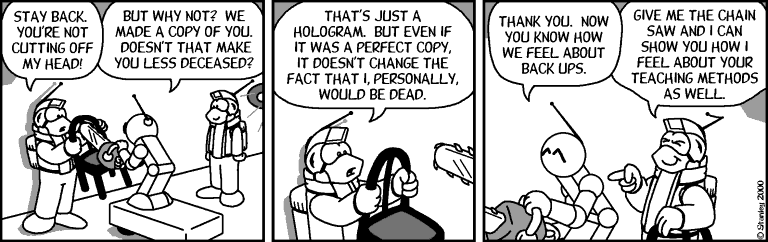
From Freefall by Mark Stanley
Monday, June 14, 2010
Why don't we have augmented reality?
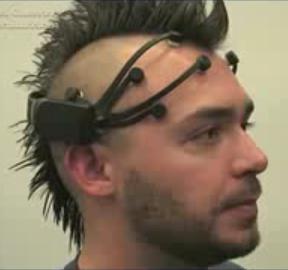
I keep seeing brainwave reading headsets being used in toys and computer games, I also recall seeing VR "sunglasses" for watching iPod movies in those "SkyMall" catalogues on airplanes. So I ask, why has no one combined the two yet? The EEG would allow someone to work a attached smartphone without touching it and the glasses would make bending over to look at it unnecessary, though the level of concentration required would probably make texting while driving ill-advised. Also it would allow Virtual reality without those bulky gloves. Granted it would be expensive, VR glasses often cost $200-$500 and the cheapest EEG headset I saw was $99, but the cool factor alone should make it profitable (you reading this, Bill Gates?)
Thursday, June 10, 2010
To all AI designers out there, program for compassion not empathy

Do you know, the difference between an Aspergarian and a psychopath? The answer is probably found in how they would respond to a Vioght-Kampf test from Blade Runner. "You are walking through the desert, you see a tortoise, you flip it over onto it's back..." An Aspie might state that they would flip the tortoise back over once it was obvious it couldn't do that itself; a psychopath would say the same, if they had figured it out, in reality they would most likely watch it bake in the sun. The difference is compassion, not empathy, the ability to gauge another's emotional responses is secondary to being able to "feel" for another.
I am stating this because some involved in the field of AI research have warned to beware of creating a superintelligence with "hyper-Asperger's". And I am worried that this may result in programmers designing an AI with a database of emotional responses and what usually triggers them, but forgetting to program actual compassion. So, at the very least we should prevent AIs from seeing Blade Runner and do a compassion test as well as the Turing test.
Sunday, May 9, 2010
Why People, Or Superintelligences, Need Others
I just finished writing my final essay for my philosophy class this semester, and realized how some of the points I brought up might be used as reasons for a Superintelligence capable of wiping out humanity and existing by itself might keep us around.
Here's the essay in full, what do you think?:
Aside from the practical reasons, mutual protection, cooperation in gathering food, reproduction, one sometimes wonders why we need other people in our lives. In Being and Nothingness Jean-Paul Sartre states that feelings such as shame, pride, etc, are due to being looked at and objectified by another. He also states that this objectification gives one density of presence. Essentially, one needs attention from someone else. But they also want control, power, when you look at me I become an object; but when I look at you, you become an object. You can take my possibilities from me, and I can do the same, you are the Other and I can subvert you. Of course, we may be entangled with others so much that other people form a large part of our identities. Even Nietzsche hinted at knowing this in his essay on the signs of high and low culture, though he had a slightly different reason for why we would need other people.
Sartre puts a lot of emphasis on “the Look” that another person gives to you. He even refers to the Look as a ‘fall’ in the pseudo-religious sense, as in a loss of innocence. The world seems to drain into the other and reduces oneself to just another object like everything else in the world to that other person. This takes away most of the possibilities available to the person being looked at, it is a loss of control. Once he arrives your possibilities are threatened by his possibilities. However the Look also gives the looked at density of presence, he feels validated. “The Other’s look confers spatiality upon me. To apprehend oneself as looked-at is to apprehend oneself as a spatializing-spatialized.”(1). And of course, you can take away the other’s possibilities just as easily as he can take away yours, which might give you a sense of control over the situation and the other, which Sartre believes is what the lover seeks. The lover wants control over how the beloved looks at him, using his own object-state to manipulate how she sees him. However, the lover also doesn’t want to “compromise the freedom of the other” as it wouldn’t be as satisfying. But most of the time a person is trying to control another, even the masochist who desires to be treated as an object is just using the dominatrix who he wants to be used by.
There is another possibility for why we need to have others in our lives, the concept of Martin Heidegger’s that we are all entangled with “the They”. You see, in everyday being with others “Da-sein stands in subservience to the others.”(2) Da-sein, loosely translated, means being-there or there-being, Heidegger used it to mean one’s personal presence, their being in the world. Being in the world we have associational relationships with various objects that exist in the world, including other people. But other people have different perspectives than one person does and your Da-sein can be easily lost in the inauthentic Da-sein of the they. The public world surrounding oneself dissolves one’s Da-sein into that of the others, disburdening individual Da-sein in its everydayness. One becomes entangled in the they and in fact falls towards the they, fleeing from self-awareness and all that painful inner worldly thinking. Actually that last sentence, and how it is stated in the book, might actually be in the wrong tense, it seems to suggest that the fall into the they hasn’t happened yet. Also the terminology suggests that “falling prey” is a bad thing when Heidegger specifically states not to place value judgments on entanglement of Da-sein. While we can’t say whether or not being entangled in the collective Da-seins of the world is a good thing it does help people get along with their day to day lives.
Friedrich Nietzsche actually had a good reason for someone to break away from the others, though he didn’t use the same terminology. He viewed tight societies as super-organisms of a sort, and he noticed that many individuals who were weakened in one organ compensated by making other organs stronger, for example a blind man had better hearing and could see deeper inwardly. To him those individuals who were less bound represented a “wound” in society that helped it to advance. In terms of functionality in society “the stronger natures retain the type, but the weaker ones help to advance it.”(3) He then goes on to divide people into “bound spirits” and “free spirits”; free spirits are strong, but also weak, especially in their actions as they have too many motives and are therefore uncertain and awkward. The bound spirit on the other hand has tradition on his side and does not need to explain his actions, allowing him to be very strong and assertive in action. A genius, a true genius not the generic IQ>150 kind of genius, would be a free spirit who can also assert himself as effectively as a bound spirit, without needing to appeal to the bound spirits. But to unlock the true potential of a genius might require one to break free from the bindings of society, in the same way that a prisoner might be inspired to develop skills related to escaping. So we need other people and specifically the tightly bound societies they form in order to create true Free Spirits, who are necessary to prevent humanity from stagnating. In addition those Free Spirits might lead to something that transcends humanity, the Ubermensch, of course that might not be a good thing, but they’ll still need normal Mensch for the same reason as the genius.
So, in effect we have two reasons why people need other people, Sartre’s “look” and both Heidegger and Nietzsche’s concepts of multiple people interacting as one person and distinction of those who break away. Although the feeling of validation given by the look and the everyday convenience of the they probably matter more to the average person than the motivating pressure of society to produce genius. But everyone wants control, control provides security, it provides stability and prevents any unexpected complications in your life and/or plans. There is no denying that other people can be a hindrance, but they can also be advantageous, if you can manipulate them properly. Plus there is the sense of satisfaction you get when you’ve made the other into just another object in the world. So the main reason why we need others is still because we want to use them. But really you can’t accept just one of those explanations on its own, they’re all entangled with one another, just like we are as individuals within the they.
References:
1. Sartre, Jean-Paul. (1956). Being and Nothingness. Philosophical Library, Inc. Page 266.
2. Heidegger, Martin. (1953) Being and Time. State University of New York (1996 reprinting). Page 118 and 199.
3. Nietzsche, Friedrich. (1878). Translated by Marion Faber (1984). University of Nebraska Press. Page 138
Thursday, April 29, 2010
Aliens, psychology by diet
When we expand into outer space, we may contact other sapient species, and it can be guaranteed that they will think differently than us. But we may be able to predict their behavior by their diet. Something that Larry Niven touched on with the carnivorous Kzinti and the herbivorous Puppeteers.
Carnivores: The first thing you should remember is that predators are opportunists, they always take the route that is least expensive. If they get to colonizing other planets I would expect them to have the capability to adapt considering their need for complex ecosystems that would be a hassle to terraform from scratch. Due to their opportunistic natures I doubt that they might go to the trouble of eating other sapient species like us humans, though if there is a massive technological difference they might enslave or domesticate the less advanced species. Relations with humanity would probably be neutral or even allies, we might colonize and terraform dead worlds while they adapt to living ones.
Herbivores: To an herbivore, any other animal is a potential enemy, a predator or a competitor. I expect that their planets would be ecological disasters devoid of any other animal species except in the most extreme regions they never got around to colonizing. Since their supporting ecosystems would be comparatively simple they would probably terraform their colonies, because of that I expect that they would use a lot of weapons of mass destruction in inter-species wars. In addition the fact that extreme paranoia would have been a survival trait in their early history (more than humans anyway) would make diplomacy with them very difficult.
Omnivores: Would probably be closest to humans psychologically, as we are omnivores ourselves. Kind of a wild card, they might terraform, they might adapt, they might exterminate, they might enslave. They might even join forces with us and form the galactic federation. Fortunately trends on earth make it seem like most sapient species will be omnivorous.
Plants: I don't see any reason for plants to become sapient, but maybe a machine civilization would be similar. In short, they wouldn't care about consumers unless we got in their way.
Wednesday, April 28, 2010
One of my Philosophy Papers
I don't really have much else to write about, so I'm posting a few of the papers I've written for my Philosophy classes.
Second Reaction Paper: The They
Paul Schroeer-Hannemann
Martin Heidegger’s idea of Da-sein and the “They” is quite intriguing, I see resemblances between his ideas and Nietzsche, as well as some similarities to concepts I’ve read about in science-fiction, and things I’ve seen in the real world. The concept that inauthentic Da-sein is entangled in the They and that only those who break away can achieve true Da-sein seems similar to one of the aspects of Nietzsche’s Übermensch, specifically rising above the herd. It seems like my favorite philosopher of the 19th century had a bigger influence than I realized. The They also reminds me of the idea of the Group Consciousness, which has often been extended into a “Hive Mind” in science-fiction.
It might seem ridiculous to imagine a large group sharing one consciousness, but it can be rather easy to change your mind on that when you witness fads and trends sweeping through the population. It’s like there’s some group mind, but not everyone is connected to it to the same extent, or that there are several collectives and each person is part of several.
It seems contradictory how Heidegger calls entanglement in the They “falling prey” and states that it is not a “fall”. Of course, he meant a “fall” in the religious manner and he originally wrote that in Deutsch. But it still seems like he’s suggesting that entanglement is a bad thing, even calling one who is entangled “inauthentic Da-sein”. Why tell people not to project value judgments while using terminology that encourages them to? It’s like he’s intentionally confusing us, or do all philosophers do that?
What does make sense is flight towards the They and away from self-awareness. People tend to feel more secure in groups and insecure when they don’t know what to do. Being part of the group distracts people from self-contemplation and the potential revelations that might bring, shattering their comfortable worldview. It’s much easier to just have someone tell you what to think, especially if it’s simple enough for a child to understand (this applies to both philosophy and science). The Emo “subculture” seems like a perfect example, teens become angsty about their worldviews being slightly shaken by puberty and what they’re taught in high school and flee from self-awareness by subsuming themselves within the They, all while under the delusion that they are expressing their individuality. Even when they try to make themselves unique they are just following the will of the They to express ones “uniqueness”. In fact it appears that the smaller the group, the more entangled its members are; or perhaps it is just easier for some members of the group to influence the others, actually that is entanglement isn’t it. It doesn’t seem like there is any way to avoid entanglement in at least one They, so I guess it’s a good thing that Heidegger said not to project value judgments on Falling Prey.
Tuesday, February 9, 2010
Armor and Authoritarianism, a possible connection?
As well everyone knows, the shiny knights of the Middle Ages were made obsolete by the invention of guns. Many also realize that with the invention of a very deadly, easy to use weapon it became much more difficult for rulers to maintain control of their subjects. It is no coincidence that governments, in particular authoritarian ones, don't last as long as they used to.
With those in mind I looked at the Wikipedia page on Roman military equipment and my suspicions were confirmed, Roman soldiers wore considerably heavier armor after Caesar took power than when Rome was a republic. Able to survive attacks that would kill someone less well protected, courtesy of their emperor, the Roman legions were able to put down peasant rebellions easily. Their successors after the empire's fall were even better suited to enforcing the will of their feudal lords. That all disappeared when the peasants became able to kill a knight at 100 paces; within a few centuries the only monarchs who hadn't been deposed were those who turned over most of their power to democratic institutions such as Britain's.
In short, when personal armor technology can effectively protect against the most commonly used weapons technology, authoritarianism thrives because armor is too expensive for the average peasant to acquire. These days most authoritarian regimes die with their first ruler. However, while the bulletproof vests given to most soldiers can be easily penetrated by a civilian hunting rifle, there have been considerable advances in personal armor tech within the last 50 years. It is possible that within a century soldiers will be nigh-invulnerable against anything short of heavy explosives.
Personally I welcome the Terran Federation and the Mobile Infantry, will be better than this democratic chaos.
Wednesday, February 3, 2010
Brain Uploading, Not Just For Immortality
If you have read my previous posts on this blog you might recall my opinion that most ways of creating a full brain emulation would not result in immortality for the original, but Roko Mijic's talk on FAI made me think about how uploading may benefit humanity in other ways. Roko mentions and even recommends using brain emulations as a stepping stone towards benevolent superintelligence, but there might be less fantastical uses for the technology if it is developed before the Singularity drives humanity into extinction.
The appeal of using brain emulations for AI is obvious, with an AI made from scratch you don't really know what to expect. Whereas an emulation theoretically gives you something with motivations you understand, or at least an easy way to teach an AI human values. Also you can easily monitor every process of an emulation, which is where I got my idea.
There are many mysteries still locked within the human mind and even if decent mind reading technology is developed it would be difficult for one to provide data on everyday activities with a brain scanner around their head. That is where uploading comes in, remember, you don't necessarily need to understand how something works to copy it. No doubt there are many psychologists who would love to pick around in someone's head to the extent that only an emulation could provide. Not to mention that an emulation of a psychopath or schizophrenic would help AI programmers recognize what not to do.
Thursday, January 7, 2010
A possibility on the future
Imagine, that technology has advanced to the point where a complete copy of your personality and memories can be made through a process as simple as an MRI is today. And that two or more people with the appropriate implants can perceive through each other's senses and "hear" each other's thoughts, to the point where it can be difficult to distinguish whose thoughts and experiences are whose. Now imagine that you have those implants and that you have an AI copy of yourself made. Once your copy is activated your implants are linked to it, the copy doesn't have a chance to form an independent thought and essentially becomes an extension of your own mind. You become much better at multi-tasking as now you essentially have two brains, you can battle orcs while you're in a meeting with your boss. You can use one brain to work while your other is on vacation. Maybe you have an android that your AI self can teleoperate if you ever need to be in two places at once. But then one day you feel a sudden flash of pain and all sensory input from your biological body cuts out, frantically you check all your life signs. Pulse: zero; brain activity: flat-lined; you come to one conclusion, you are dead.
Subscribe to:
Posts (Atom)